
Graves County Court Records After Arrest
A Graves County arrest record and a Graves County court record are not the same file. The jail roster starts with booking. It may show arrest agency, arrest date, charge description, case number, OTN, bond rows, detainers, custody location, and release information. The court record begins when the case moves into District Court or Circuit Court through a complaint, information, indictment, citation, or other filing accepted by the court.
For custody and booking details, use the Graves County jail inmate records path. For booking photos, use the Graves County jail mugshots record path. Court records after a jail arrest focus on filed charges, docket events, bond orders, warrants, hearing dates, amendments, dismissals, pleas, convictions, and expungement status. A roster charge can be changed by the prosecutor or court, so it should be treated as a starting point, not the final case history.
The Kentucky Court of Justice Graves County page lists the temporary courthouse at 1102 Paris Road, Suite 21, Mayfield, KY 42066. Circuit Court Clerk Emily Ward Buzanis is the local court-record contact, and the listed phone number is 270-247-1733. Confirm current hours with the clerk because the main court page found during research did not display a current hours table.
Search Court Records After Arrest
The jail roster is useful before searching the court side because it can provide the spelling, booking number, case number, OTN, offense date, charge description, and court tab details. Those clues help narrow a docket search or a clerk request. The Kentucky Court of Justice docket portal is free, but its own notice says the docket is not an official docket and is subject to change. Use it for scheduling and case clues, then request certified or complete case records from the clerk of the court that heard the case.
- Search the Graves County Bluehorse roster and write down the person's name, charge description, case number if shown, OTN, offense date, and any court-tab entries.
- Open the Kentucky Court of Justice docket portal and choose Graves County from the county selector.
- Use the docket result as a scheduling clue. Do not treat it as a certified case record or proof of final charge status.
- Call or visit the Graves Circuit Court Clerk for case-copy availability, older files, and official records from the court that heard the case.
- For sheriff arrest reports or incident narratives, send a precise open-records request to the Graves County sheriff custodian.
The successful capture of the Kentucky Court of Justice Graves County page shows the local court contact point for court records after a Graves County jail arrest.
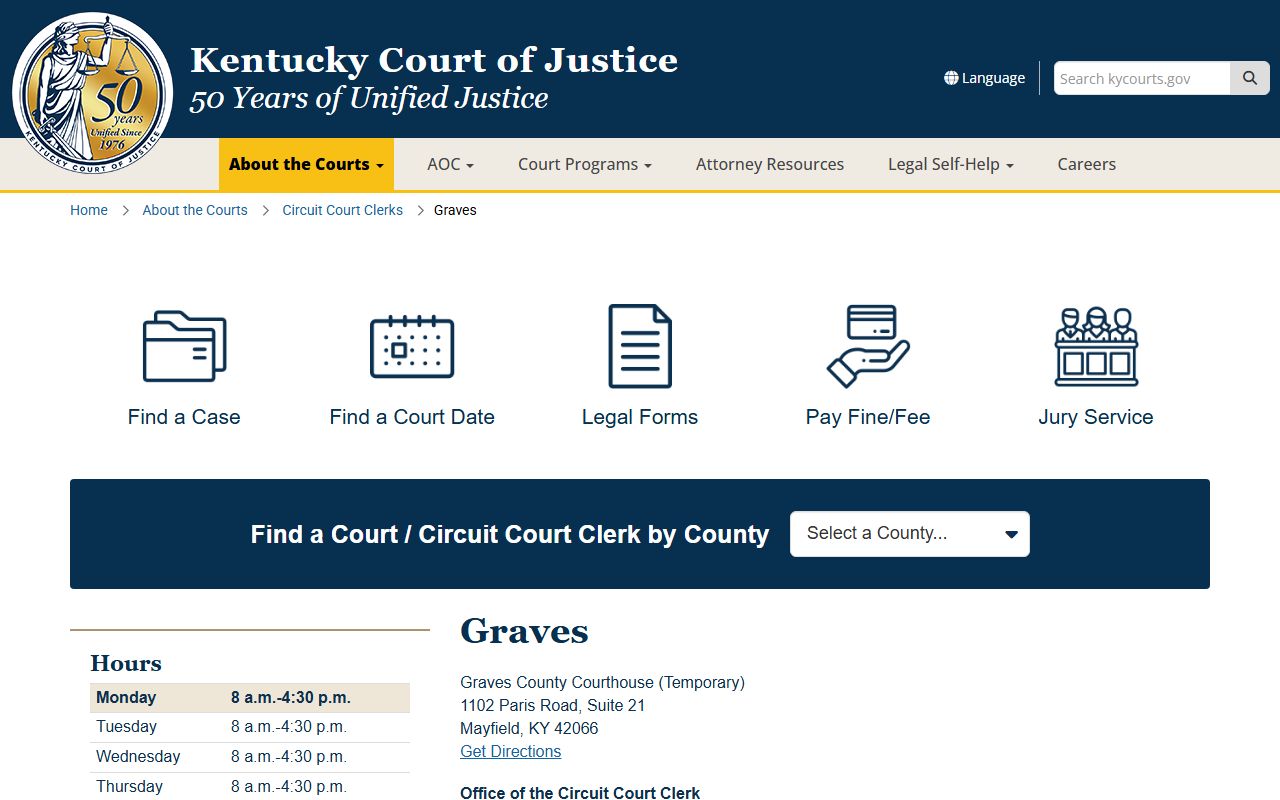
The court page is the local bridge from jail booking information to clerk-held criminal case records.
Graves County Docket Fields
The docket portal is dynamic, and the text capture did not expose every control. The research did confirm a county-selection control and the portal notice that dockets are not official and may change. That means a Graves County court-record search should avoid invented field labels. Searchers should use the published portal controls as displayed, then contact the clerk for copies and case-record review.
| Field Label | Type | Required | Options / Format Notes |
|---|---|---|---|
| Select a County to Generate Docket | Dropdown | Yes for docket generation | Select Graves County for local docket output. |
| Date / docket filters | Dynamic or unspecified | Unspecified | The captured text did not expose all dynamic controls, so use labels shown in the live portal. |
The state docket portal screenshot is a successful manifest image that matches the court-record lookup process.
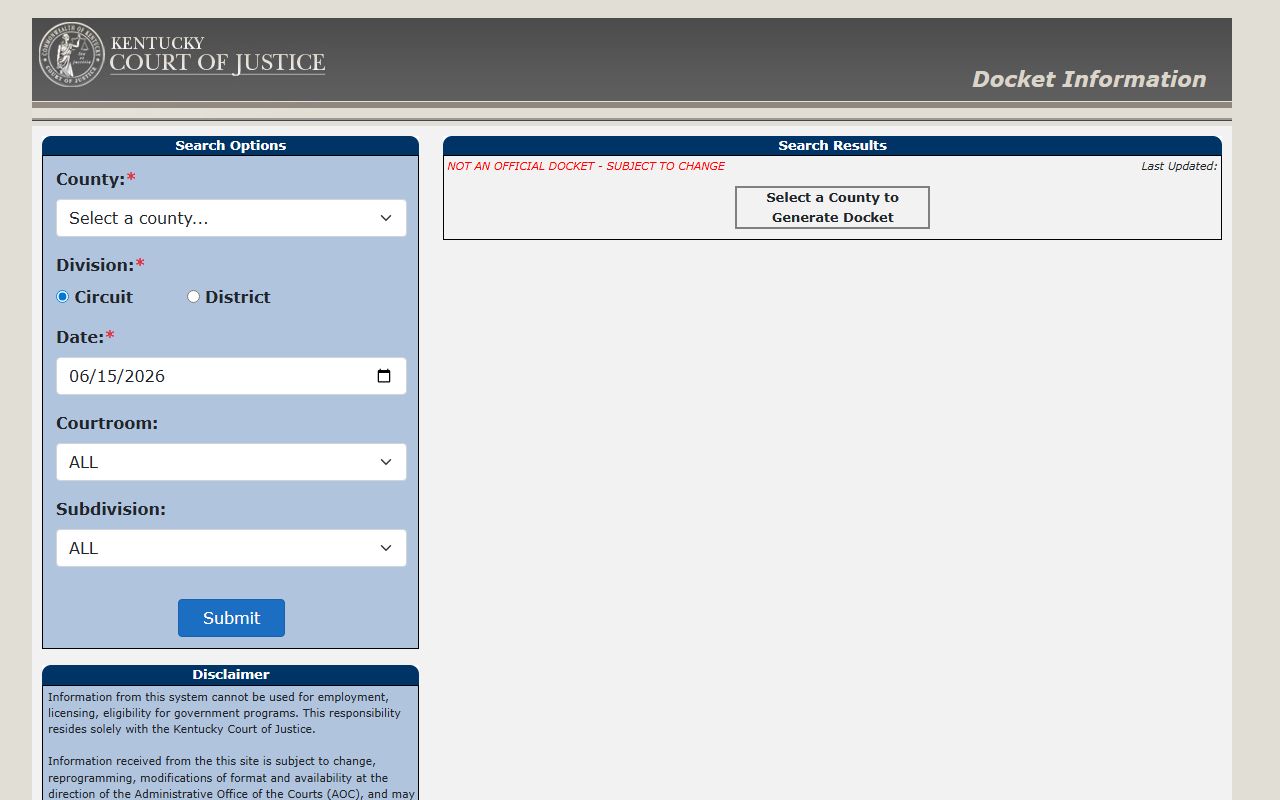
Because the portal is a docket tool, the clerk remains the records source for copies, file review, and official availability questions.
Graves County Charging Documents
Court records after a Graves County jail arrest usually become clearer when the charging document is identified. A booking charge can be entered by law enforcement or jail staff based on the arrest event. The filed court charge is controlled by the prosecutor and court process. Misdemeanors and preliminary felony matters may proceed in District Court. Felonies handled by the Commonwealth's Attorney proceed in Circuit Court through indictment, information, waiver, or related felony procedure.
| Document | Who Uses It | What It Means |
|---|---|---|
| Complaint | Officer or prosecutor | Starts or supports a criminal accusation in court, often near the arrest stage. |
| Information | Prosecutor | A formal prosecutor-filed charge used when permitted by law and court procedure. |
| Indictment | Grand jury | A felony charging document after grand-jury action. |
Kentucky does not use the title "District Attorney" for Graves County. The Graves County Attorney handles many lower-level and county matters, and the Commonwealth's Attorney handles felony prosecution in Circuit Court. The Graves County Attorney listed in the research is John Cunningham. The 52nd Circuit Commonwealth's Attorney for Graves County is George Powers, with Paris Road office listings found in state and association sources.
Graves County Charge Status
Charge status is the reason court records after a jail arrest must be checked separately from the roster. A jail entry may show a charge at intake, but the filed case can be amended, reduced, dismissed, enhanced, replaced, or resolved by plea or trial. A case may also include a warrant, detainer, bond condition, or failure-to-appear issue that affects custody even when one charge is no longer active.
| Status | What It Means |
|---|---|
| Pending | The charge or case is active and has not reached final disposition. |
| Dismissed | The prosecutor or court ended the charge without a conviction on that charge. |
| Amended or reduced | The filed charge changed after review, negotiation, court order, or later case development. |
| Indictment | A grand jury charging document, most often tied to felony prosecution. |
| Information | A formal prosecutor-filed charge in a case where that filing path is permitted. |
| Disposition | The outcome or current procedural status of a charge. |
| Conviction | A finding or admission of guilt, which is not the same as arrest or booking. |
Note: A person may be released from jail while the court case remains pending, or remain in custody because of another hold.
Bond After Graves County Arrest
Bond information can appear on the jail roster, in court orders, or through Pre-Trial Services. The Graves County jail bond page says some offenses have preset bonds. If there is no preset bond, the person meets with Pre-Trial Services within 24 hours of booking, and Pre-Trial works with local judges to establish bond. During courthouse hours, bonds are paid at the courthouse. Cash and surety bonds may be paid at the jail only when the courthouse is closed, and the published local rule says cash-only exact change is required.
| Bond Type | Local Meaning |
|---|---|
| ROR bond | Release on own recognizance, based on a signed promise to return to court. |
| Surety bond | A judge-approved signer, often a spouse or parent, takes on the monetary burden if the person misses court. |
| Unsecured bond | A monetary amount is assigned, but no money is due at release unless conditions fail. |
| Partially secured bond | A judge-set percentage must be paid before release. |
| Property bond | Bond secured by property; Graves County says this can only be done at the courthouse. |
A bond on one case does not clear every custody issue. Call the jail before paying to confirm the current amount, court status, and whether a detainer, probation or parole issue, federal hold, ICE hold, or out-of-county warrant remains.
Warrants After Court Records
No official Graves County active-warrant search page was found in the sheriff site pages inspected. That changes the access path. A bench warrant, arrest warrant, search warrant, or fugitive warrant may be visible only after an arrest creates a booking record or after a court docket entry appears. For non-emergency warrant and process questions, call Sheriff Jon Hayden's Graves County Sheriff's Office at 270-247-4501 or the Graves Circuit Court Clerk at 270-247-1733. Do not rely on the absence of a jail roster result as proof that no warrant exists.
The sheriff tip channel uses West Kentucky Crime Stoppers and P3 Tips. Beginning May 1, 2024, the sheriff tip line page says tipsters can text WKY to 738477 for a link to submit an anonymous tip or use the P3 Tips app. That channel is for tips, not self-clearance, custody confirmation, or court-record certification.
Charges vs Convictions
Graves County court records after an arrest may show accusations long before a final result. A charge means the person has been accused through the justice process. A conviction means guilt was found or admitted by plea, trial, or another legally recognized disposition. Treating a charge as a conviction is a serious records mistake.
| Question | Charge | Conviction |
|---|---|---|
| Stage | Accusation or filed count | Final or resolved finding of guilt |
| Can it change? | Yes, it may be amended, reduced, or dismissed | Changes usually require later court action |
| Custody effect | May affect bond or holds | May affect sentence, supervision, or state custody |
| Record meaning | Not proof of guilt | Shows a case outcome unless later vacated or expunged |
Sealed and Expunged Records
Kentucky law includes an expungement path for certain acquittals, dismissals, and cases that do not result in indictment or information. The research identifies KRS 431.076 as the relevant statute for those qualifying outcomes. Expungement is a court process, not a jail-roster button. Once a court expunges qualifying records, agencies may remove or delete official records according to the order and law.
| Question | Sealed | Expunged |
|---|---|---|
| Public visibility | Hidden from ordinary public view when a sealing order applies. | Removed or treated as legally erased under the expungement order. |
| How it happens | By court authority or statutory rule. | By court expungement process under eligible Kentucky law. |
| Does the jail decide? | No, the jail follows valid legal authority. | No, the court process controls qualifying expungement. |
| Common trigger | Restricted access or protected record category. | Acquittal, dismissal, or no indictment or information when the statute applies. |
Juvenile records, medical material, protected personal data, active-investigation material, and sealed court files may be withheld or redacted. The Kentucky Open Records Act gives inspection rights, but it also allows exemptions and redactions when another law protects the material.
Graves County Court Record Requests
The Kentucky Court of Justice court-record request page says requests for copies and case-record review start with the clerk of the court that heard the case. That is the cleanest path for older files, closed files, certified copies, and details that do not appear on the docket portal. For jail records tied to the same arrest, the Graves County Jail open-records process uses a written, signed, dated request by mail, fax, or in person. For sheriff records, Chief Deputy Jeremy K. Prince is the records custodian listed by the sheriff page.
Kentucky open-records law matters across these channels. KRS 61.870 defines public agency, public record, custodian, and resident. KRS 61.872 gives Kentucky residents the right to inspect public records except as otherwise provided. KRS 61.880 sets the five-business-day agency response rule and Attorney General review process for denials.
Important: Court, jail, and sheriff records may answer different parts of the same arrest. Verify final case status with the clerk.